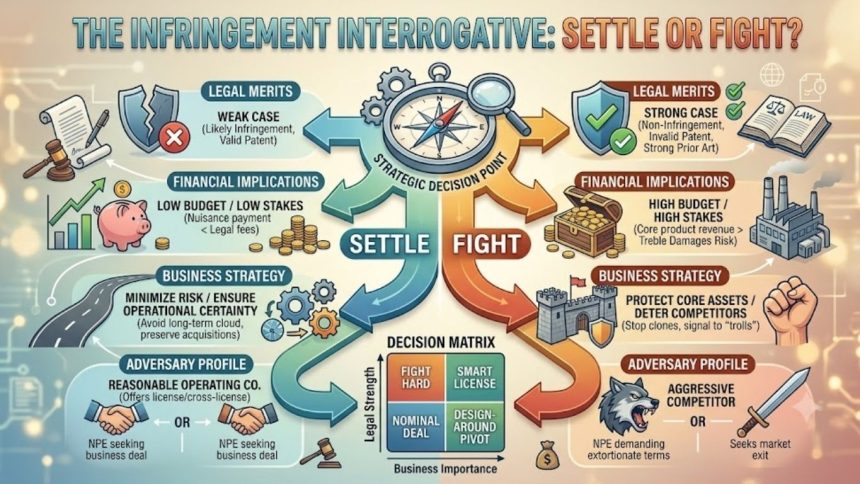
Receiving notice of a patent infringement claim presents an immediate strategic challenge for any company. Whether your organization is enforcing proprietary rights against a competitor or defending a product line from an unexpected accusation, the path forward carries significant financial and operational consequences.
Determining whether to negotiate a resolution or proceed through formal litigation requires evaluating legal merits, financial exposure, and overall corporate objectives.
Evaluating the Strategic Landscape
A patent claim rarely boils down to a simple right-or-wrong scenario. Before choosing a direction, business leaders must conduct a thorough, objective assessment of the dispute.
Assessing Patent Validity and Enforceability
The strength of the underlying patent forms the primary foundation of any claim. If you are defending against an accusation, investigating prior art can uncover evidence that invalidates the opposing party’s claims.
Conversely, if your business owns a granted patent, confirming its ability to withstand scrutiny before filing or escalating a claim is vital. A patent that contains questionable claims or procedural vulnerabilities during its prosecution stage creates substantial risk in court.
Analyzing the Degree of Overlap
Infringement requires that an accused product or process meets every element of at least one claim in a patent. Technical experts should review the accused item side-by-side with the patent language.
A high degree of technical overlap favors the patent holder. If clear differences exist, or if the product can be easily modified to design around the patent without sacrificing performance, the alleged infringer gains significant leverage.
When Fighting in Court Makes Strategic Sense
While courtroom battles are resource-intensive, certain situations demand a firm legal stance.
Protecting Core Market Share and Unique Innovations
When the dispute involves a flagship product that generates a vast majority of company revenue, settling on terms that compromise market exclusivity can cause permanent commercial damage.
If a competitor directly copies a unique, patented feature to siphon away market share, litigating to secure an injunction may be necessary to preserve business value.
Deterring Predatory Competitors and Nuisance Claims
Yielding to weak claims can mark a business as an easy target for future demands. When an assertion is clearly baseless or driven by entities seeking quick payouts, mounting a strong defense signals to the market.
Establishing a firm reputation for defending proprietary assets deters future frivolous actions.
Setting Valuable Precedents
Enforcing intellectual property rights across an entire sector sometimes requires a favorable court ruling to establish legal clarity. Winning a high-profile infringement suit confirms the validity of your portfolio, deters broader industry infringement, and increases the valuation of existing patents.
When Settling Out of Court is the Smarter Path
In many disputes, reaching a commercial resolution provides greater long-term value than pursuing a court verdict.
Controlling Financial Expenditures
Patent litigation frequently costs millions of dollars in legal fees, administrative overhead, and expert testimony. If the maximum potential recovery or liability is lower than the projected cost of trial, continuing the fight makes little financial sense.
Settling early preserves working capital for product development, hiring, and core growth initiatives.
Removing Business Uncertainty
Court trials introduce unpredictable outcomes. A single jury decision can alter product roadmaps or impose heavy financial penalties.
Settling allows leadership to control the narrative, negotiate flexible licensing agreements, structure manageable royalty schedules, or establish transition timelines without risking an abrupt market exit.
Preserving Key Industry Relationships
In tightly connected markets, opponents in a patent dispute may also be key suppliers, distributors, or prospective joint-venture partners. Protracted court battles damage professional networks.
Transitioning a dispute into a cross-licensing agreement or strategic partnership turns a legal threat into a productive business relationship.
Balancing Costs and Commercial Goals
Choosing between settling and fighting is ultimately a business calculation, not an emotional response. Aligning legal strategies with corporate goals requires balancing short-term expenses against long-term market positioning.
Consulting an experienced business litigation attorney in Utah or another qualified legal advocate ensures that every option is weighed carefully before committing to a course of action.