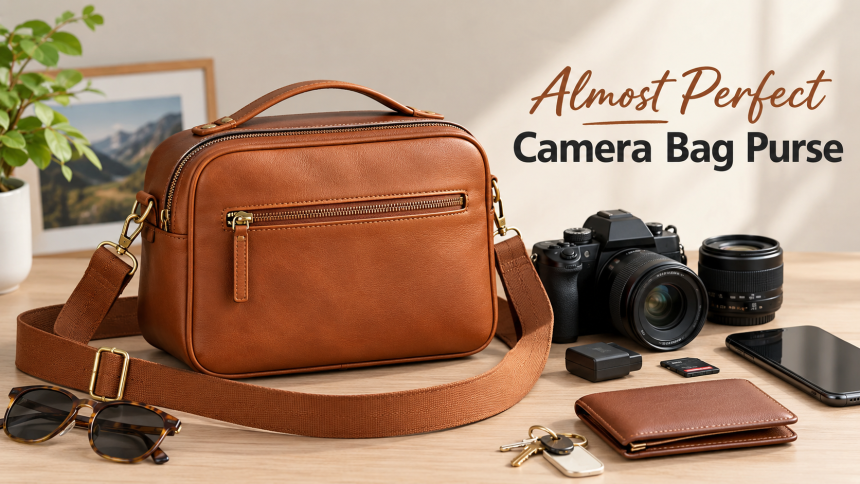
An almost perfect’ camera bag purse is a practical hybrid accessory designed to carry a camera and everyday personal items in a compact, purse-like format. It typically combines padded protection, adjustable compartments, and a shoulder or crossbody strap with a more stylish appearance than a traditional camera case. These bags can suit photographers who want quick access to a camera while carrying essentials such as a phone, wallet, keys, or small accessories.
What Is an Almost Perfect’ Camera Bag Purse?
An almost perfect’ camera bag purse combines the protective features of a camera bag with the everyday convenience of a handbag or purse. Instead of looking like conventional photography equipment, this type of bag is generally designed to blend into casual or professional outfits while keeping camera equipment organized.
The term can also be used when shoppers are searching for a particular product or brand name, so it is useful to check the exact product listing before assuming that every similarly described bag has the same construction or capacity. Features can vary considerably between models, especially regarding padding, compartment size, materials, and strap design.
How Is It Different From a Regular Camera Bag?
A traditional camera bag usually prioritizes equipment capacity and dedicated protection, while a camera purse emphasizes portability and everyday styling. Camera purses often have smaller compartments and are intended for a camera body, one lens, and personal belongings rather than a complete photography kit.
This makes them particularly relevant for street photography, travel, casual photography, events, and everyday carrying. Someone using several large lenses, a professional flash, or a full-frame camera with a long telephoto lens may need a larger dedicated camera backpack instead.
What Should an Almost Perfect’ Camera Bag Purse Hold?
The right capacity depends on the camera equipment and personal items you expect to carry regularly. A compact mirrorless camera may fit comfortably alongside a small lens and basic accessories, while a larger DSLR setup requires substantially more internal space.
Before buying, consider the size of the camera body with the lens attached rather than looking only at the bag’s external dimensions. Also check whether the interior dividers can be moved, because adjustable dividers allow the same compartment to accommodate different equipment configurations.
Typical Items to Carry
A camera purse may be able to accommodate:
- Camera body
- Standard or compact zoom lens
- Spare battery
- Memory cards
- Lens cloth
- Smartphone
- Wallet
- Keys
- Small personal accessories
The exact capacity depends on the individual model, so manufacturer dimensions and interior photographs are more useful than the general label “camera purse.”
How Important Is Camera Protection?
Protection is one of the main reasons to choose a camera-specific purse instead of an ordinary handbag. Look for padded walls, a cushioned base, secure closures, and dividers that prevent the camera from moving around inside the bag.
Water resistance is another useful feature, but water-resistant fabric is not necessarily the same as waterproof construction. If the bag will be used outdoors frequently, check whether the manufacturer specifies a water-resistant exterior, protective rain cover, or sealed construction.
Is an Almost Perfect’ Camera Bag Purse Comfortable for Everyday Use?
Comfort depends largely on the strap, weight distribution, and size of the bag. A wide adjustable shoulder strap can distribute weight more comfortably than a narrow strap, particularly when the camera and personal belongings are carried together.
Crossbody designs can also keep the bag closer to the body, which may make it easier to walk around while photographing. However, adding more equipment increases the overall weight, so a compact camera purse is generally most comfortable when used for a limited photography setup.
What Features Should You Check Before Buying?
The most useful features are those that match your camera size, carrying habits, and protection requirements. Comparing these details before purchasing can prevent problems such as a camera fitting in the bag but not fitting comfortably with its lens attached.
1. Interior Dimensions
Measure your camera and lens together and compare those measurements with the bag’s usable interior dimensions. Do not rely solely on the stated exterior dimensions because padding and dividers reduce the available internal space.
2. Adjustable Dividers
Removable or adjustable dividers make it easier to separate the camera from lenses and accessories. They are particularly useful if you change your equipment configuration over time.
3. Closure System
Zippers, magnetic closures, buckles, and flap designs offer different levels of convenience and security. A zipper generally provides a more enclosed compartment, while a flap or magnetic closure can allow faster access.
4. Strap Design
Check whether the strap is adjustable and whether its attachment points appear suitable for the intended weight. A detachable strap can also make the bag more versatile for everyday use.
5. Material
Common materials include canvas, nylon, polyester, synthetic leather, and leather. The material affects appearance, weight, durability, and resistance to moisture, so the best choice depends on how and where the bag will be used.
Can You Use a Camera Bag Purse Without a Camera?
Yes, a camera purse can also function as an everyday bag when its compartments are large enough for personal belongings. The padded interior can be useful for protecting sunglasses, electronics, or other delicate items.
However, dedicated camera padding can occupy more space than the lining of an ordinary handbag. If photography is only an occasional activity, consider whether the additional structure is useful for your normal daily carrying needs.
Common Mistakes When Choosing a Camera Purse
The most common mistake is choosing a bag based on appearance without checking whether the camera actually fits comfortably. A bag may look spacious externally but have limited usable space because of thick padding or fixed compartments.
Another mistake is purchasing more capacity than necessary. An oversized bag can become unnecessarily heavy once filled, while a very small bag may force the camera and accessories into a cramped arrangement that provides less protection.
How to Choose the Right Size
Choosing the right size starts with identifying the equipment you normally carry rather than the equipment you might purchase someday. Make a simple list of your camera body, lens, spare battery, memory cards, and personal essentials.
Then compare that list against the bag’s internal dimensions, divider configuration, and weight. If you regularly carry more than one large lens or additional photography equipment, a conventional camera shoulder bag or backpack may be more practical than a purse-style design.
Final Thoughts on an Almost Perfect’ Camera Bag Purse
An almost perfect’ camera bag purse can be a useful middle ground between a traditional camera case and an everyday handbag, particularly for photographers who carry a compact setup. The key considerations are internal dimensions, padding, adjustable dividers, strap comfort, closure design, and weather protection. Before choosing one, compare those features with your actual camera equipment and everyday carrying needs, and consider related options such as camera crossbody bags and compact camera backpacks.