AI is rapidly changing the way music is written, arranged, recorded, and produced. But for serious music producers, simply typing a prompt and receiving a finished song is not always enough. Producers often want control over the melody, lyrics, vocal expression, instruments, arrangement, and final sound.
That is where ACE Studio Artist Lifetime 2.0 AI Music Production Studio becomes interesting.
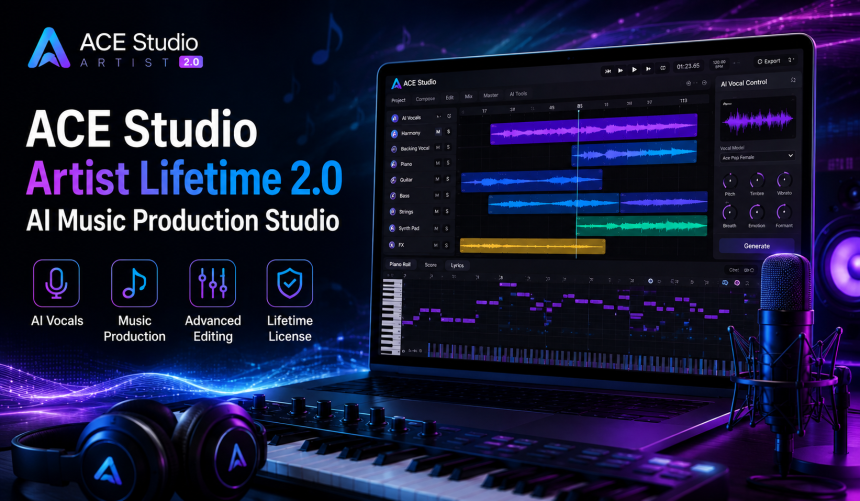
ACE Studio 2.0 combines AI vocal synthesis with a growing collection of AI-assisted music production tools. Instead of positioning itself only as an automatic song generator, it gives musicians a more hands-on environment where AI can become part of the actual production workflow.
If you are considering the ACE Studio Artist 2.0 Lifetime license, this guide explains what it does, its most important features, how the lifetime license works, its advantages and limitations, and who should consider buying it.
What Is ACE Studio Artist Lifetime 2.0?
ACE Studio 2.0 is an AI-powered music production environment designed primarily for musicians, producers, songwriters, composers, and creators who want greater control over AI-generated vocals and musical elements.
One of its biggest attractions is its AI Singing Voice Generator.
Instead of recording a singer for every demo or vocal idea, you can provide MIDI notes and lyrics and use an AI singing model to perform the vocal line. The result can then be edited in much greater detail than a typical one-click AI song generator allows.
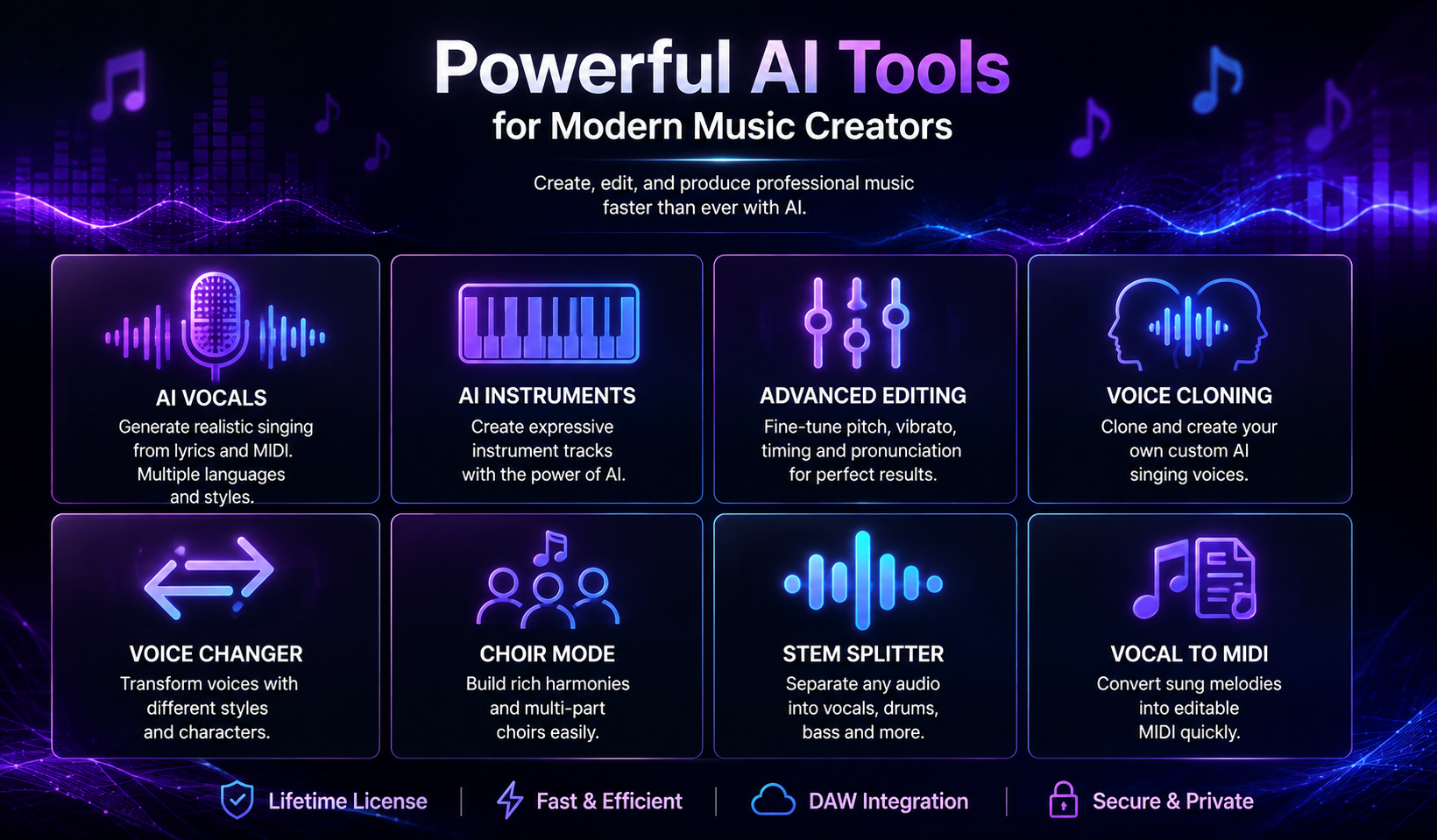
ACE Studio has also expanded beyond vocals. Depending on the current version and plan, its ecosystem includes tools such as AI instruments, voice cloning, voice changing, stem separation, Vocal-to-MIDI features, generative music tools, and DAW integration.
This makes ACE Studio 2.0 better understood as an AI-assisted production workspace rather than simply an AI singer.
ACE Studio Artist Lifetime 2.0 Key Features
1. AI Singing Voice Generator
The vocal synthesis system remains one of the strongest reasons to consider ACE Studio.
You can start with MIDI notes, enter your lyrics, select an available AI singer, and generate a vocal performance around your composition.
This is especially useful when you already know what melody you want.
Instead of asking AI to decide the entire song for you, you remain the composer. ACE Studio becomes something closer to a virtual session vocalist that performs the notes and lyrics you provide.
That distinction matters.
For producers who care about musical control, being able to determine the notes first can make ACE Studio far more useful than a completely prompt-driven music generator.
2. Detailed Vocal Editing
Generating a vocal is only the beginning.
ACE Studio gives producers control over important elements of vocal expression. Depending on the voice and workflow, you can work with characteristics such as:
- Pitch
- Pronunciation
- Vibrato
- Breathing
- Dynamics
- Vocal tension
- Falsetto
- Emotional expression
This level of control is particularly valuable when the first generated performance is close to what you want but still needs refinement.
A producer can spend time shaping a phrase instead of repeatedly generating completely new songs and hoping that one version gets the vocal right.
3. Large Selection of AI Voices
ACE Studio provides a substantial library of premade AI singing voices covering different vocal colors, genres, and languages.
The exact number of available voices can change as ACE Studio evolves, so buyers should check the current Artist plan before purchasing rather than relying on an older number shown on a reseller page.
The important point is variety.
Different productions require different singers. A soft pop track may need a completely different vocal character from cinematic music, R&B, electronic music, rock, or a choir arrangement.
Having multiple voices available inside one ecosystem makes experimentation much easier.
4. Multiple Language Support
ACE Studio is not limited to English-language music.
Its current ecosystem supports AI singing across multiple languages, making it potentially useful for producers creating music for international audiences.
Language support can vary between individual voice models, so it is worth checking whether your preferred singer supports the language you plan to use.
For multilingual producers, this is an important advantage because pronunciation is one of the hardest parts of realistic vocal synthesis.
5. VoiceMix and Vocal Customization
Finding a voice that is almost perfect can be frustrating.
One singer may have the warmth you want while another has the brighter tone that fits the production.
ACE Studio’s voice customization capabilities are designed to give producers more flexibility over vocal character instead of forcing every project into a single preset voice.
For creative producers, this can turn the AI singer into something closer to an instrument that can be shaped around the track.
6. Custom AI Voice Cloning
Another major feature is the ability to create a custom AI singing model from suitable vocal recordings.
This has several interesting applications.
A singer could potentially create a digital version of their own singing voice for production workflows. A producer working with an authorized vocalist could build a reusable model where the necessary permissions are in place. Artists could also experiment with their own vocal identity without recording every line from scratch.
There is an important ethical and legal rule here:
Only clone voices when you have the necessary rights and permission to use the source recordings and voice.
AI voice technology is powerful, but consent and ownership still matter.
7. AI Voice Changer
ACE Studio also includes voice-changing capabilities.
Instead of creating a vocal entirely from MIDI and lyrics, voice conversion can be useful when a performance already exists and you want to explore a different vocal character.
This creates another workflow for producers who prefer to record the timing, phrasing, and emotion themselves before using AI as part of the final vocal design.
8. AI Instruments
ACE Studio 2.0 expands the concept beyond AI singers with AI-powered instruments.
The available ecosystem includes instrument models designed to respond to musical input with more realistic expression than simply triggering a static sample.
This is particularly interesting for producers who do not have access to live instrumentalists but still want expressive parts in their arrangements.
However, this is also an area where expectations should remain realistic. Independent reviews of ACE Studio 2.0 have praised its vocal capabilities more consistently than every part of its newer instrument workflow.
In other words, AI vocals remain one of the clearest strengths of ACE Studio, while some of the broader all-in-one production features may continue improving over time.
9. Choir Mode
Creating convincing vocal harmonies manually can take a surprising amount of time.
ACE Studio’s choir-oriented workflow allows producers to combine multiple AI voices and build layered vocal arrangements much faster.
That can be useful for:
- Pop backing vocals
- Gospel-style arrangements
- Cinematic choirs
- Children’s choir textures
- Opera-inspired arrangements
- Large harmony sections
For producers who regularly create vocal-heavy music, this can save considerable production time.
10. Stem Splitter
Stem separation has become an important tool in modern production.
ACE Studio includes stem-separation functionality that can help separate elements from mixed audio for further editing and creative work.
Possible uses include remix preparation, arrangement study, extracting elements from your own older projects, and creating material for a new production workflow.
As always, separating audio technically does not automatically give you copyright permission to reuse somebody else’s protected recording.
11. Vocal to MIDI
Vocal-to-MIDI conversion can be extremely convenient when an idea starts as a sung melody rather than notes drawn inside a piano roll.
A producer can use the vocal performance as a starting point for editable MIDI information and continue developing the idea from there.
This is exactly the kind of feature that makes AI valuable without removing the musician from the creative process.
12. Generative AI Music Tools
ACE Studio 2.0 has also introduced generative features intended to help with composition and arrangement.
Tools in the current ecosystem include concepts such as generating ideas, adding musical layers, and enhancing existing material.
This changes the role of ACE Studio.
Earlier versions were easier to describe primarily as AI vocal software. Version 2.0 is clearly moving toward a broader AI music production studio where vocals, instruments, generative assistance, and editing can live closer together.
13. ACE Bridge and DAW Integration
Professional producers rarely want an AI application completely isolated from the rest of their studio.
ACE Studio addresses this through ACE Bridge, which helps connect ACE Studio with compatible DAW workflows.
Support around the current product ecosystem includes major plugin formats such as VST3, AU, and AAX.
That matters if your main production environment is a traditional DAW and you want ACE Studio to become part of an existing workflow instead of replacing everything you already use.
For many experienced producers, this may be one of the most important practical features.
What Does “Artist Lifetime” Actually Mean?
This is one of the most important questions buyers ask.
ACE Studio offers a Lifetime option in supported regions, allowing users to make a one-time purchase rather than continually paying for the corresponding subscription.
ACE Studio’s support documentation describes its lifetime access as 999 years of access to the purchased plan. The company also states that the benefits remain aligned with the corresponding current plan tier.
However, there is another detail buyers should understand about ACE Studio 2.0 Lifetime.
ACE Studio’s one-time purchase documentation states that users retain the benefits of the purchased tier and receive future updates within version 2.
Therefore, do not interpret the word “Lifetime” as an automatic promise that every future major version ever released will necessarily be included.
Always read the current licensing and upgrade terms before purchasing.
ACE Studio Artist vs Artist Pro
ACE Studio offers different tiers, including Artist and Artist Pro.
The regular Artist Lifetime tier is likely to be sufficient for many individual musicians and producers who mainly want AI vocals, core AI production functionality, and a limited amount of custom-model capacity.
Artist Pro is designed for users who require more capacity, particularly around custom models, storage, and higher-tier benefits.
For example, reseller specifications have shown the standard Artist Lifetime package with fewer custom vocal/voice-changer slots than Artist Pro.
The practical question is not simply:
“Which version has more features?”
A better question is:
“How many custom voices and advanced resources will I genuinely use?”
If you are an individual producer experimenting with one primary custom voice, Artist may make more financial sense.
If you run a production business, work with multiple vocalists, or expect to maintain several custom voice models, Artist Pro deserves closer consideration.
Is ACE Studio Artist Lifetime Royalty-Free?
This question needs a more careful answer than a simple yes.
ACE Studio states that it does not claim copyright ownership over the outputs users generate. Its licensing documentation also says that most premade vocal synth voices are royalty-free, while its premade AI instruments and premade voice-changer models are royalty-free.
However, some third-party vocal models require a separate commercial license.
That distinction is extremely important.
Before commercially releasing a track, check the license attached to the exact voice you used.
You are also responsible for having the appropriate rights to your input material, including lyrics, recordings, stems, reference audio, and other copyrighted material.
So the safest rule is:
Check the license of the individual model and make sure you own or have permission to use everything you upload.
Can You Use ACE Studio for Commercial Music?
Generally, yes, subject to the licensing conditions of the specific models and source material involved.
That makes ACE Studio potentially useful for:
- Original music releases
- YouTube productions
- Client demos
- Advertising music
- Film and video projects
- Game music
- Songwriting demos
- Independent artist releases
- Social media productions
Again, commercial permission for an AI-generated vocal does not erase copyright restrictions on the underlying song.
If you create an AI cover of somebody else’s copyrighted composition, for example, you may still need the appropriate rights or licenses for that composition.
How Does ACE Studio Artist 2.0 Work?
A basic vocal workflow can be surprisingly straightforward.
You create or import your MIDI melody, add lyrics to the notes, select an AI singing voice, generate the performance, and then refine the result.
From there, you can work on pronunciation, expression, dynamics, pitch, breathing, vibrato, and other performance characteristics before bringing the vocal into the wider production.
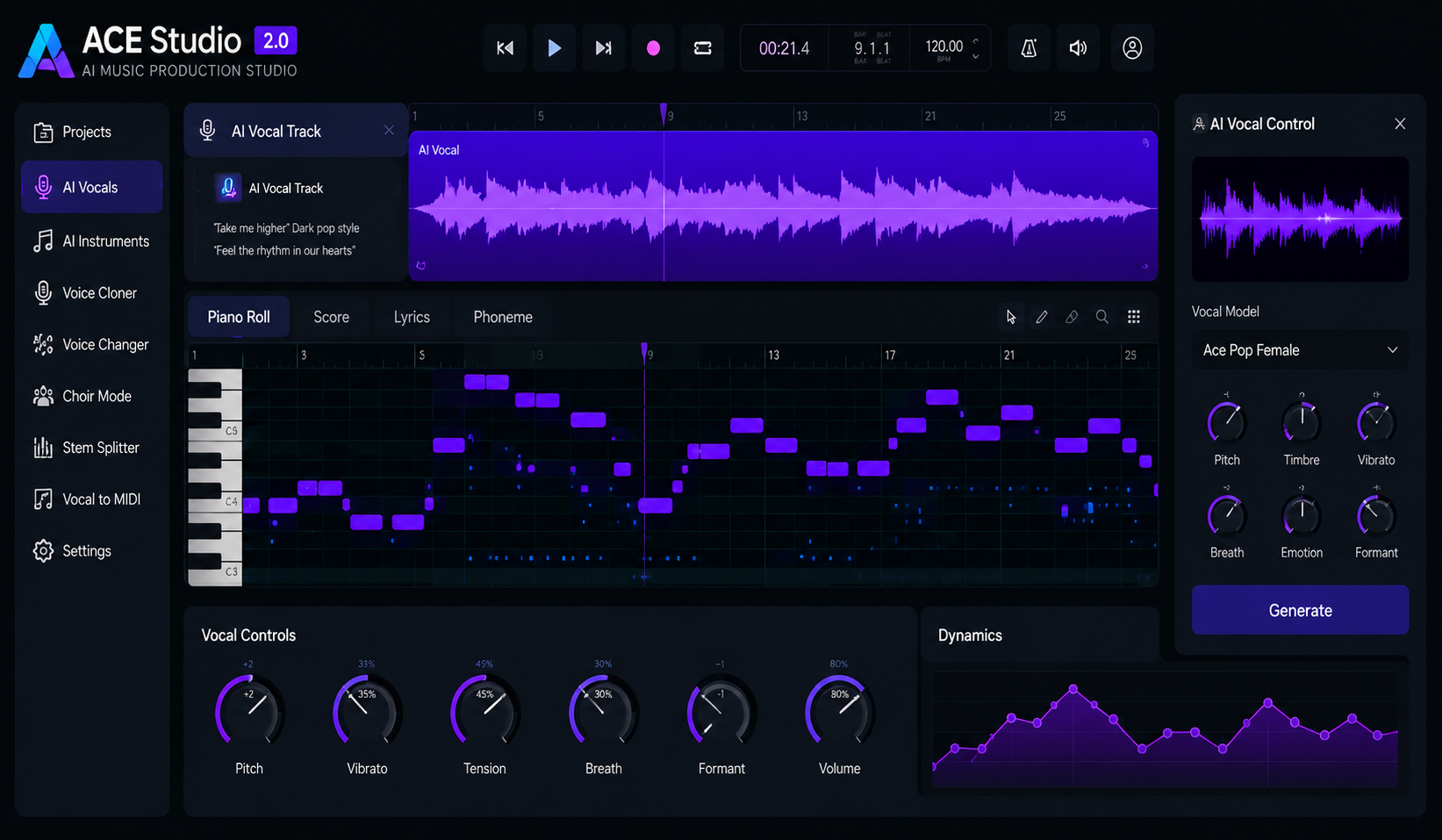
The key advantage is control.
You are not simply asking:
“Make me a pop song.”
You are telling the virtual singer exactly what melody to sing and what words to perform, and then shaping how that performance should feel.
For musicians, that difference is significant.
Who Should Buy ACE Studio Artist Lifetime 2.0?
ACE Studio Artist Lifetime 2.0 makes the most sense for people who expect to use AI vocals repeatedly rather than occasionally.
Music Producers
If you regularly need lead vocals, backing vocals, demo singers, harmonies, or experimental vocal textures, a virtual vocalist can become a genuine production tool.
Songwriters
A songwriter can hear a composition performed without waiting to book a vocalist for every early demo.
That can make it easier to test melody, key, lyrics, harmony, and arrangement before taking a song into final production.
Independent Artists
Independent musicians often work with limited budgets.
ACE Studio can help during songwriting and pre-production when hiring multiple session singers for every experiment would be impractical.
Content Creators
Creators producing original music for videos, games, advertisements, social content, or other media may appreciate the combination of AI vocals and broader production tools.
Producers Working Across Languages
The multilingual voice ecosystem can be valuable for producers experimenting with international releases or multilingual projects.
ACE Studio 2.0 vs Traditional Vocal Recording
AI vocals and human singers should not necessarily be viewed as enemies.
A talented human singer brings personality, improvisation, emotional interpretation, physical performance, and creative decisions that are difficult to reduce to parameters.
ACE Studio offers something different: speed, repeatability, editability, and access.
Need to change one word?
Change it.
Want to test a different melody?
Edit the MIDI.
Need another harmony?
Build it.
Want to hear the song in another vocal character before committing to a final vocalist?
Try another model.
For pre-production alone, this flexibility can be extremely useful.
ACE Studio vs Synthesizer V
People researching ACE Studio frequently compare it with Synthesizer V, and the comparison makes sense because both can create singing performances from notes and lyrics.
Synthesizer V has a strong reputation as a focused vocal-synthesis environment.
ACE Studio’s direction with version 2.0 is broader.
Rather than focusing exclusively on the virtual singer concept, ACE Studio is combining AI vocals with instruments, voice cloning, voice conversion, stem tools, generative features, and a larger AI-production workflow.
If your only priority is dedicated singing synthesis, comparing both products carefully is worthwhile.
If you specifically want a wider AI-production environment around the vocal workflow, ACE Studio 2.0 becomes especially interesting.
ACE Studio vs Suno and Other Prompt-Based AI Music Generators
ACE Studio and prompt-to-song generators solve different problems.
A tool such as Suno is attractive when you want to describe a song and receive a complete musical result quickly.
ACE Studio is more appealing when you want to produce rather than simply generate.
With ACE Studio, the attraction is being able to control musical information such as the melody, lyrics, singer, phrasing, and production workflow more directly.
Think of it this way:
Prompt-based song generator:
“Create a song for me.”
ACE Studio-style workflow:
“Here is my song. Help me perform and produce it.”
That difference explains why ACE Studio can be particularly attractive to musicians who already understand MIDI, arrangement, songwriting, or DAW production.
Advantages of ACE Studio Artist Lifetime 2.0
There is a lot to like about the concept.
Excellent focus on AI vocals: Vocal synthesis remains one of ACE Studio’s most compelling capabilities.
High level of control: MIDI and lyric-based workflows give musicians much more control than one-click song generation.
Custom voice possibilities: Authorized voice cloning opens interesting workflows for artists and professional producers.
Multiple AI tools in one environment: Vocals, instruments, stem tools, conversion features, and generative assistance reduce the need to jump between unrelated services.
DAW-friendly approach: ACE Bridge makes more sense for established producers who already have a preferred DAW.
Lifetime purchase option: For long-term users, paying once can be more attractive than maintaining another permanent subscription.
Commercial possibilities: Many ACE Studio models and outputs can be used commercially under the applicable licensing conditions.
Limitations You Should Know Before Buying
No serious review should discuss only the advantages.
It Does Not Replace Every Part of a Professional DAW
ACE Studio 2.0 has become much broader, but producers should not automatically assume it replaces a mature DAW and every plugin in an established studio.
For many users, the best workflow may be ACE Studio alongside their existing DAW.
AI Vocals Still Need Production Skills
AI does not eliminate the need for good songwriting.
Weak lyrics, awkward melodies, poor arrangements, and bad mixing will not magically become professional simply because the singer is AI-generated.
The best results still come from good musical decisions.
Some Features Can Be Resource Intensive
Modern AI audio processing can demand significant computing resources, particularly when work is processed locally.
Check the latest system requirements before purchasing, especially if you use an older computer.
Licensing Still Requires Attention
“AI-generated” does not mean “copyright-free.”
You still need to check voice licenses, source-material rights, cover-song requirements, and permissions for cloned voices.
Lifetime Does Not Mean Ignoring the Fine Print
The lifetime offer is attractive, but buyers should understand what version, tier, upgrades, services, and future features are actually included under the current terms.
Is ACE Studio Artist Lifetime 2.0 Worth It?
For the right producer, it can be.
If you frequently create songs and regularly need editable vocals, the value proposition is much stronger than it is for somebody who only wants to generate a fun AI song occasionally.
The ACE Studio Artist Lifetime 2.0 AI Music Production Studio is particularly compelling when you value:
- Detailed control over AI singing
- MIDI-to-vocal production
- Editable lyrics and melodies
- Multiple vocal characters
- Custom voice workflows
- AI-assisted instruments and production
- DAW integration
- Long-term access without a conventional recurring subscription
If your main goal is simply typing a sentence and receiving a complete finished song in seconds, a prompt-first AI music generator may be easier.
But if you are a musician who wants AI to fit inside your creative process, rather than replace that process, ACE Studio deserves serious consideration.
Frequently Asked Questions
Is ACE Studio Artist 2.0 a lifetime license?
A Lifetime purchase is available in supported regions. ACE Studio’s support documentation describes lifetime access as 999 years. Current documentation for the ACE Studio 2.0 one-time license also states that future updates within version 2 are included. Check the latest terms before purchase.
What is ACE Studio Artist Lifetime 2.0 used for?
It is an AI-powered music production solution centered around AI singing vocals, with additional tools for voice cloning, voice changing, AI instruments, stem processing, generative assistance, and integration with broader music-production workflows.
Can ACE Studio generate vocals from MIDI and lyrics?
Yes. This is one of its core features. You can provide MIDI notes and lyrics and use an AI singing model to generate the vocal performance.
Does ACE Studio support custom voices?
Yes. ACE Studio provides custom voice-training capabilities subject to the limits of your plan. Only use recordings and voices that you have the legal right and permission to use.
Can ACE Studio vocals be used commercially?
Many can. ACE Studio states that most premade vocal synth voices are royalty-free, but certain third-party voices require separate licensing. Always check the individual model’s license before commercial release.
Does ACE Studio work with a DAW?
ACE Studio provides ACE Bridge integration for compatible DAW workflows and supports major plugin formats within its current ecosystem.
Is ACE Studio better than Synthesizer V?
Neither is automatically better for every user. Synthesizer V is strongly focused on vocal synthesis, while ACE Studio 2.0 is expanding into a broader AI music-production environment. The better choice depends on whether you primarily want a virtual singer or a wider collection of AI production tools.
Is ACE Studio like Suno?
Not exactly. Suno-style tools emphasize generating complete songs quickly from prompts. ACE Studio gives producers more direct control over MIDI, lyrics, vocal performances, and production elements.
Is ACE Studio suitable for beginners?
A beginner can learn it, but producers familiar with MIDI, piano-roll editing, songwriting, and DAWs will generally understand its deeper value more quickly.
Is ACE Studio Artist Lifetime worth buying?
It can be a strong investment for producers who expect to create AI vocals regularly over a long period. Occasional users should compare the lifetime cost with their actual expected usage before purchasing.
Final Verdict
ACE Studio Artist Lifetime 2.0 is most interesting not because it can make music with AI, but because it gives musicians meaningful control over how AI participates in making that music.
That is an important difference.
The strongest use case remains the producer who already has an idea—a melody, lyrics, chord progression, demo, or arrangement—but needs a flexible way to turn that idea into a convincing vocal production.
Its AI singing technology can reduce the distance between writing a melody and hearing it performed. Voice customization and cloning expand the creative possibilities, while AI instruments, stem tools, generative features, and DAW integration push ACE Studio toward a much larger production ecosystem.
It is not a replacement for musical skill, and it does not make every traditional production tool unnecessary. In fact, experienced producers may get the most from ACE Studio by combining it with the DAW, plugins, instruments, and mixing workflow they already know.
For creators who want instant complete songs from a short prompt, other AI platforms may offer a faster path.
For creators who want control, editability, repeatability, and an AI vocalist that can become part of a serious production workflow, ACE Studio Artist Lifetime 2.0 is a far more interesting proposition.