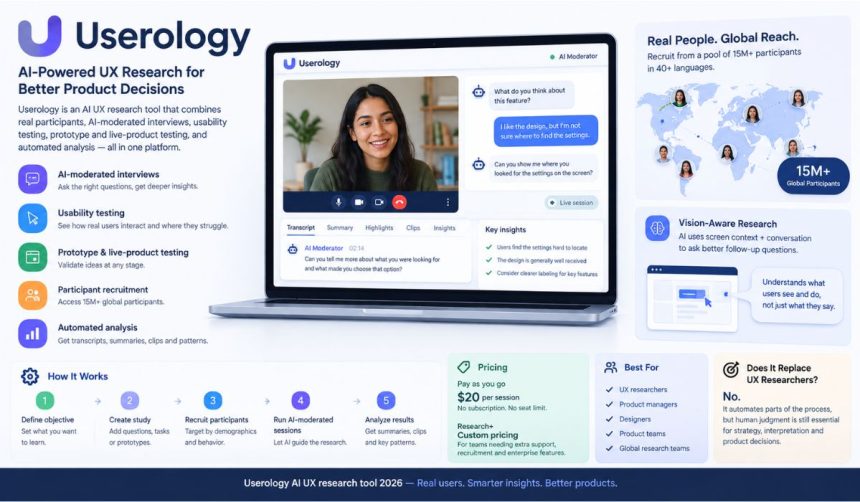
Userology is an AI UX research tool in 2026 that combines AI-moderated interviews, usability testing, prototype and live-product testing, participant recruitment, and automated research analysis. Its main distinction is that the AI can use screen context during evaluative research rather than relying only on spoken answers. Userology also uses real participants, supports multilingual research, and offers session-based pricing, making it relevant for product, UX, and research teams that need to run studies without manually moderating every session.
What is Userology?
Userology is an AI-powered UX research platform designed to help teams conduct user interviews and usability studies with AI handling much of the moderation and analysis. Instead of requiring a researcher to schedule and personally moderate every participant session, the platform can conduct AI-moderated research and produce transcripts, summaries, clips, and synthesized findings.
The important distinction is between AI-moderated research and AI-generated participants. Userology’s current pricing information says its research sessions use real, recruited participants, while AI performs the moderation and analysis. That makes the platform different from tools that rely primarily on synthetic users for feedback.
Who is Userology designed for?
Userology is primarily relevant to teams that need recurring user research rather than a single interview. Typical users can include UX researchers, product managers, designers, product teams, and organizations conducting usability or product research across different markets.
It can be particularly useful when a team needs to evaluate a website, prototype, application, or product experience with multiple participants and wants a consistent research process across sessions.
How does Userology AI UX research work?
Userology uses AI to moderate research sessions while participants interact with the research material or product being tested. The platform’s vision-aware approach is designed to let the AI take screen context into account when generating follow-up questions during evaluative research.
A typical workflow can be understood in five stages:
- Define the research objective: The researcher determines what needs to be learned, such as whether users can complete a checkout process.
- Create the research study: Questions, tasks, prototypes, or product experiences are prepared for participants.
- Recruit participants: Userology provides access to a global participant pool with demographic and behavioral targeting. Its current pricing page lists a pool of more than 15 million participants.
- Run AI-moderated sessions: The AI conducts the interview or guides participants through the research tasks.
- Analyze the results: Transcripts, summaries, clips, patterns, and other research outputs help the team identify recurring findings.
This workflow can reduce the amount of repetitive moderation and initial analysis that researchers have to perform manually, while researchers still need to interpret findings and connect them to product decisions.
What are Userology’s main features in 2026?
Userology combines several UX research functions in one platform, including interviews, usability testing, participant recruitment, and AI-assisted analysis.
AI-moderated user interviews
Userology can conduct AI-moderated interviews in which the system asks questions and follows the participant’s responses. This can make it possible to run more sessions without requiring a researcher to personally moderate each conversation.
The platform’s pricing page currently lists both AI-moderated user interviews and open-ended discovery interviews among its research capabilities.
AI usability testing
Usability testing focuses on whether people can successfully use an interface or complete specific tasks. Userology supports AI-moderated usability testing and can be used for prototype and live-product testing.
For example, a product team could ask participants to find a particular feature, complete a purchase, or navigate a new onboarding flow. The resulting research can help identify where users become confused or experience friction.
Vision-aware research
One of Userology’s notable capabilities is its use of screen context during research. According to Userology’s published comparison material, its AI combines a language model with computer vision so it can observe interface interactions and use that context for follow-up questions.
This matters because users do not always describe every usability problem verbally. A participant might say that a page is “fine” while hesitating, clicking repeatedly, or struggling to locate a control. Screen-aware research can provide additional context around those interactions.
Prototype and live-product testing
The platform supports both prototype and live-product testing. That allows teams to use AI-moderated research at different points in the product development process rather than limiting research to early concept interviews.
For instance, a designer could evaluate a prototype before development, while a product team could later test the same type of task on a production website.
Automated transcripts and summaries
Userology provides full session transcripts, automated summaries, video clips, highlights, and AI synthesis or pattern detection.
These features are particularly useful when a study contains many sessions. Instead of manually reviewing every recording from beginning to end before identifying recurring themes, researchers can use automated outputs as a starting point for deeper analysis.
Can Userology recruit real participants?
Yes. Userology’s current pricing information states that its sessions use real, recruited participants, and it lists a global participant pool of more than 15 million people. Demographic and behavioral targeting are also included in the listed capabilities.
This distinction is important when evaluating AI UX research platforms. AI moderation can automate the researcher’s role during a session, but it does not necessarily mean that the participants themselves are artificial. In Userology’s stated model, the AI moderates research involving real people.
For research where genuine user behavior matters, participant quality and recruitment criteria remain just as important as the AI technology.
What types of UX research can you conduct with Userology?
Userology covers several research approaches rather than being limited to conversational interviews. Its current platform information lists AI-moderated interviews, usability testing, prototype and live-product testing, and open-ended discovery research. Research+ also adds capabilities such as longitudinal or multi-session studies and custom AI interview flows.
Common use cases
Usability testing: Determine whether people can complete important product tasks and where they encounter friction.
Prototype testing: Gather reactions and behavioral evidence before a design is fully developed.
Product discovery: Explore user needs, expectations, and experiences through open-ended interviews.
Concept testing: Evaluate an idea, feature, message, or proposed product direction with target users.
Mobile research: Userology’s published materials describe native mobile-app testing as part of its broader research capabilities.
Information architecture research: Published Userology materials also describe methods such as tree testing and card sorting for evaluating navigation and content structures.
How much does Userology cost in 2026?
Userology currently advertises a $20-per-session pay-as-you-go plan, with no recurring subscription or seat limit listed on its pricing page. It also offers a Research+ option for organizations requiring additional support, recruitment assistance, custom research workflows, and enterprise-oriented capabilities.
| Plan | Current pricing information | Best suited to |
|---|---|---|
| Pay as you go | $20 per session | Teams running individual or recurring studies |
| Research+ | Custom | Teams needing managed recruitment, support, custom workflows, and enterprise controls |
The pay-as-you-go model is notable because teams are charged according to research usage rather than buying a fixed number of seats. Userology also states that its platform access includes a free trial and does not require a credit card to start that trial.
Because pricing can change, researchers should verify the live pricing page before budgeting a larger research program.
What does Userology include for research analysis?
Userology’s analysis layer is designed to turn individual research sessions into findings that can be reviewed across a study. The listed capabilities include automated insight summaries, AI synthesis and pattern detection, transcripts, video clips, highlights, shareable reports, and team comments.
For teams conducting many interviews, this can address one of the biggest practical problems in qualitative research: the amount of time required to process recordings and transcripts.
However, automated synthesis should be treated as an analytical aid rather than an unquestionable final conclusion. Researchers still need to check whether a reported theme is supported by the underlying participant evidence and whether the sample actually represents the intended audience.
Does Userology replace a UX researcher?
No. Userology can automate parts of research execution, but it does not eliminate the need for research strategy and human judgment.
A UX researcher still needs to decide what question is worth investigating, recruit an appropriate audience, design unbiased tasks, interpret contradictory evidence, understand business and product constraints, and determine which findings deserve action. AI moderation can make research more scalable, but scaling a poorly designed study simply produces more data without necessarily producing better decisions.
This distinction is especially important for exploratory or sensitive research, where experienced human moderation may be valuable for recognizing subtle context and adapting the conversation appropriately.
What are the advantages of Userology in 2026?
The strongest argument for Userology is the combination of AI moderation, real participants, usability testing, and automated analysis in one research workflow. Rather than treating interviews, participant recruitment, and analysis as completely separate processes, the platform brings these activities together.
Other potential advantages include:
- Real participant research rather than relying solely on synthetic feedback.
- AI moderation for running sessions at greater scale.
- Screen-aware research for evaluative UX tasks.
- Prototype and live-product testing within the same general workflow.
- Automated transcripts and summaries for faster initial analysis.
- Global participant recruitment with demographic and behavioral targeting.
- Session-based pricing instead of a conventional per-seat subscription.
What should teams consider before using Userology?
The biggest consideration is that AI automation does not automatically guarantee high-quality research. The quality of a study still depends on its research question, participant sample, tasks, moderation instructions, and interpretation of the evidence.
Teams should also distinguish between discovery research and evaluative research. Evaluative studies with defined tasks can be particularly suitable for AI-assisted moderation because the research structure is easier to standardize. More ambiguous discovery studies may benefit from a human researcher who can recognize unexpected themes and change the direction of an interview deliberately.
Cost should also be evaluated against the complete research workflow. A $20 session price is easy to understand, but the total study budget can also depend on the number of sessions, participant requirements, recruitment complexity, and any Research+ services needed.
Is Userology suitable for global UX research?
Userology is designed for international research and its current pricing page advertises multilingual interviews in more than 40 languages, while other published Userology materials describe broader language coverage.
For a global study, researchers should still validate language availability for the exact participant experience they plan to use. Language support is not only about translating questions; researchers also need to consider cultural differences, recruitment criteria, task familiarity, and whether the research method behaves consistently across markets.
A multilingual AI moderator can make international research easier to scale, but the study design should still account for local context.
Userology vs traditional UX research
Traditional moderated UX research usually requires a researcher to recruit participants, schedule sessions, conduct interviews, review recordings, code findings, and prepare reports. Userology attempts to automate several of these operational steps through AI moderation, participant recruitment, and automated analysis.
That does not mean the two approaches are mutually exclusive. A research team could use Userology for high-volume evaluative studies while reserving human-moderated sessions for complex discovery work, sensitive subjects, or studies requiring deeper expert probing.
The practical question is therefore not simply whether AI is better than human research. It is whether a particular research task benefits from automation without sacrificing the quality of evidence required for the decision.
Frequently asked questions about Userology AI UX research tool 2026
Is Userology an AI usability testing tool?
Yes. Userology offers AI-moderated usability testing alongside interviews, prototype testing, live-product testing, and other UX research methods.
Does Userology use real users?
Yes. Userology states that its sessions use real, recruited participants. Its current pricing information lists a global participant pool of more than 15 million.
How much is Userology?
The currently advertised Pay-as-you-go plan is $20 per session. Userology also offers a Research+ plan with additional enterprise and managed-research capabilities.
Can Userology test prototypes?
Yes. Prototype testing is listed among its current AI-moderated research capabilities.
Can Userology test a live product?
Yes. Live-product testing is included in the platform’s listed capabilities.
Does Userology replace human UX researchers?
No. It can automate moderation, recruitment-related operations, and parts of analysis, but research planning, evidence evaluation, and product interpretation still require human judgment.
Conclusion
Userology AI UX research tool 2026 is best understood as an AI-assisted research platform that combines real-user recruitment, AI moderation, usability testing, prototype and product evaluation, and automated research analysis. Its $20-per-session pay-as-you-go pricing and vision-aware approach make it particularly relevant to teams that want to scale structured UX studies without turning every session into a manually moderated interview.
For a broader evaluation, the next useful topics are AI usability testing tools, Userology alternatives, and how AI-moderated UX research compares with traditional moderated research.